

1. Introduction: Allocation of emissions allowances is central to the GX-ETS
Following its initial voluntary phase, Japan’s emissions trading system, the GX-ETS, entered its second, mandatory phase in April 2026. It covers around 300–400 companies and covered companies are obliged to calculate CO2 emissions, set targets, and submit a first “Transition Plan” by 30 September. When fully operationalized, it is expected to become one of Japan’s major policy tools for supporting corporate carbon neutrality and progress toward national climate targets. (See Climate Integrate’s What’s GX-ETS? report, released in March 2026, for more details.)
A key feature of the second phase of the GX-ETS is the allocation of emissions allowances, which covered companies receive from the government every year. In some other emissions trading systems, such as the EU ETS, companies must pay for at least part of their allowances. Under the second phase of the GX-ETS, however, companies receive them for free. The allocation amount determines the scale and pace of emission reductions expected from covered companies. Therefore, allocation is central to the credibility and effectiveness of the GX-ETS.
This analysis examines benchmark-based allocation in the power and steel sectors, two of Japan’s largest-emitting sectors, to test how far allocation amounts can be approximated from publicly available information*. The cases identify the limits of assessments based on public data and point to the need to enhance transparency.
* Publicly available information refers mainly to company disclosures such as integrated reports, sustainability reports and published company data, supplemented where relevant by government or electricity statistics.
2. What is needed to assess benchmark-based allocation
Benchmark-based allocation depends on four main elements: (1) the applicable benchmark indicator and covered activity, (2) activity data, (3) the benchmark level or emissions intensity standard applied, and (4) emissions data corresponding to the same activity scope. Together, these elements determine the amount of allowances companies receive.
Data requirements differ by sector and process. In the power sector, the relevant activity data are thermal power generation by fuel type. In the steel sector, process-specific data are required, such as pig iron production, crude steel production, and fuel consumption.
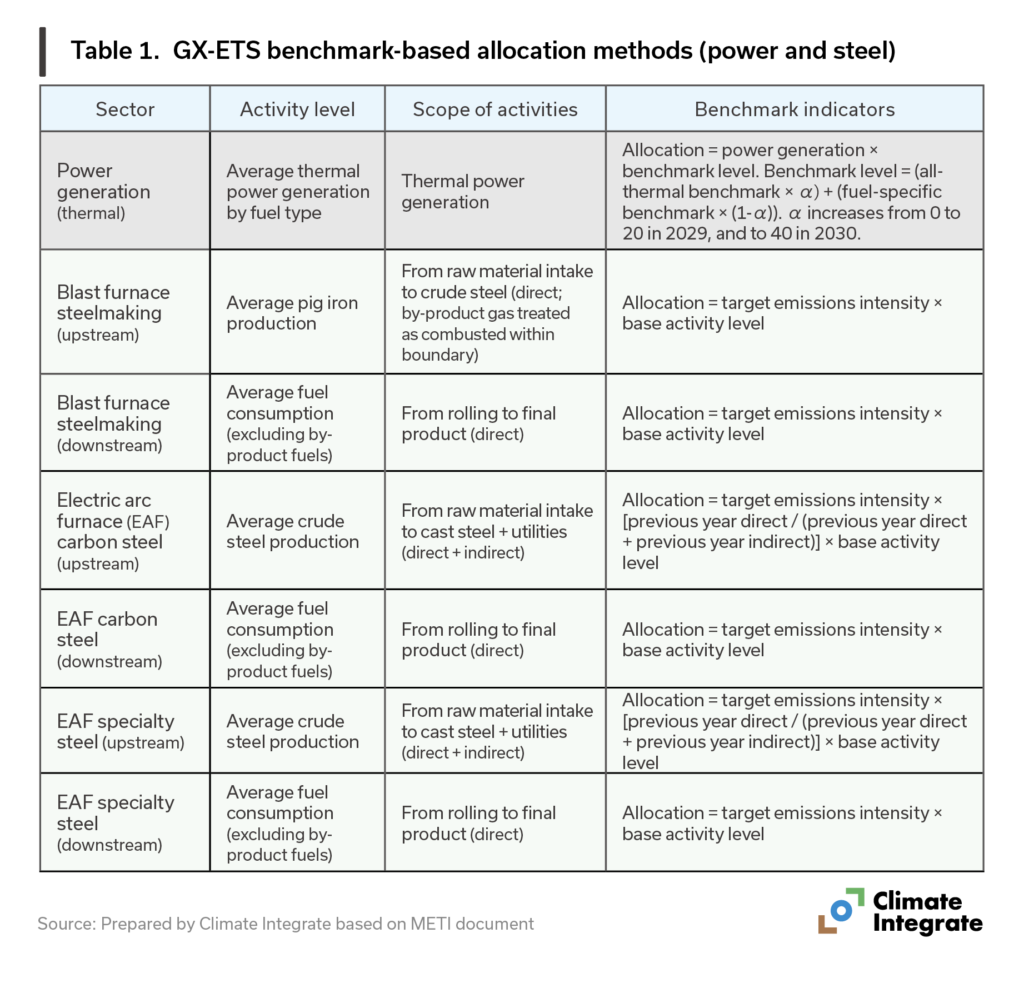
The methods for calculating allowance allocations in the power and steel sectors are shown in Table 1.
Source details
Prepared by Climate Integrate based on METI document (in Japanese)
The following sections apply these indicators to selected power and steel companies to test how far allocation amounts can be calculated from publicly available information.
3. Power sector cases: JERA and J-POWER
For the power sector, the benchmark calculation uses thermal power generation by fuel type as the activity metric.
In the case of JERA, the largest thermal power company in Japan, domestic power generation by fuel and domestic emissions are disclosed. This makes it possible to approximate the information needed to assess benchmark-based allocation. However, the publicly available data do not specify whether the disclosed domestic generation data match the thermal power generation covered by GX-ETS allocation, and fuel-specific emissions are not available.
For J-POWER, the second largest thermal power company, the link to the benchmark is less direct. J-POWER’s public disclosure provides aggregated domestic power generation data that includes non-fossil power generation. To isolate the coal-fired generation relevant to the benchmark, these data need to be checked against public electricity generation data and approximated. J-POWER discloses domestic emissions, but corresponding emissions data for GX-ETS allocation are not publicly available.
This shows that useful information is publicly available in the power sector, but some benchmark-relevant details remain missing, including the exact activity scope used for GX-ETS allocation and fuel-specific emissions.
4. Steel sector cases: Nippon Steel and JFE Steel
For the steel sector, benchmarks require process-specific data. For blast furnace steelmaking, these include pig iron production for upstream processes and fuel consumption excluding by-product fuels for downstream processes. For electric arc furnace (EAF) steelmaking, they include crude steel production and the split between direct and indirect emissions for upstream processes, as well as fuel consumption for downstream processes. Across these benchmarks, the data need to correspond to the activity covered by each GX-ETS benchmark.
For Nippon Steel, the company provides some useful production and emissions information, but only one data point appears close to the required form: pig iron production for blast furnace upstream processes. Even there, it remains unclear whether the coverage matches the activity covered by the GX-ETS benchmark. Other required data, including downstream fuel consumption excluding by-product fuels and emissions data corresponding to each steel benchmark, are not publicly available in the form needed for the steel benchmarks.
JFE Steel provides crude steel data and energy-related data that can support rough estimates for some benchmarks. For the blast furnace upstream benchmark, pig iron production is not disclosed directly. This would need to be approximated from crude steel production using assumptions about pig iron input per unit of crude steel output. For the blast furnace downstream benchmark, disclosed energy data may indicate the broad scale of energy use, but they do not isolate fuel consumption excluding by-product fuels for the downstream process. For EAF benchmarks, the required activity and emissions data are also not publicly available in benchmark-relevant form.
This shows that company disclosure can support rough estimates in the steel sector, but company-wide production, energy, and emissions data do not map cleanly onto the benchmark indicators and activity scope used for allocation. Benchmark-relevant data remain unavailable, including downstream fuel consumption excluding by-product fuels, emissions data corresponding to each steel benchmark. For JFE, pig iron production needed for the blast furnace upstream benchmark is also not directly disclosed.
5. Disclosure matters
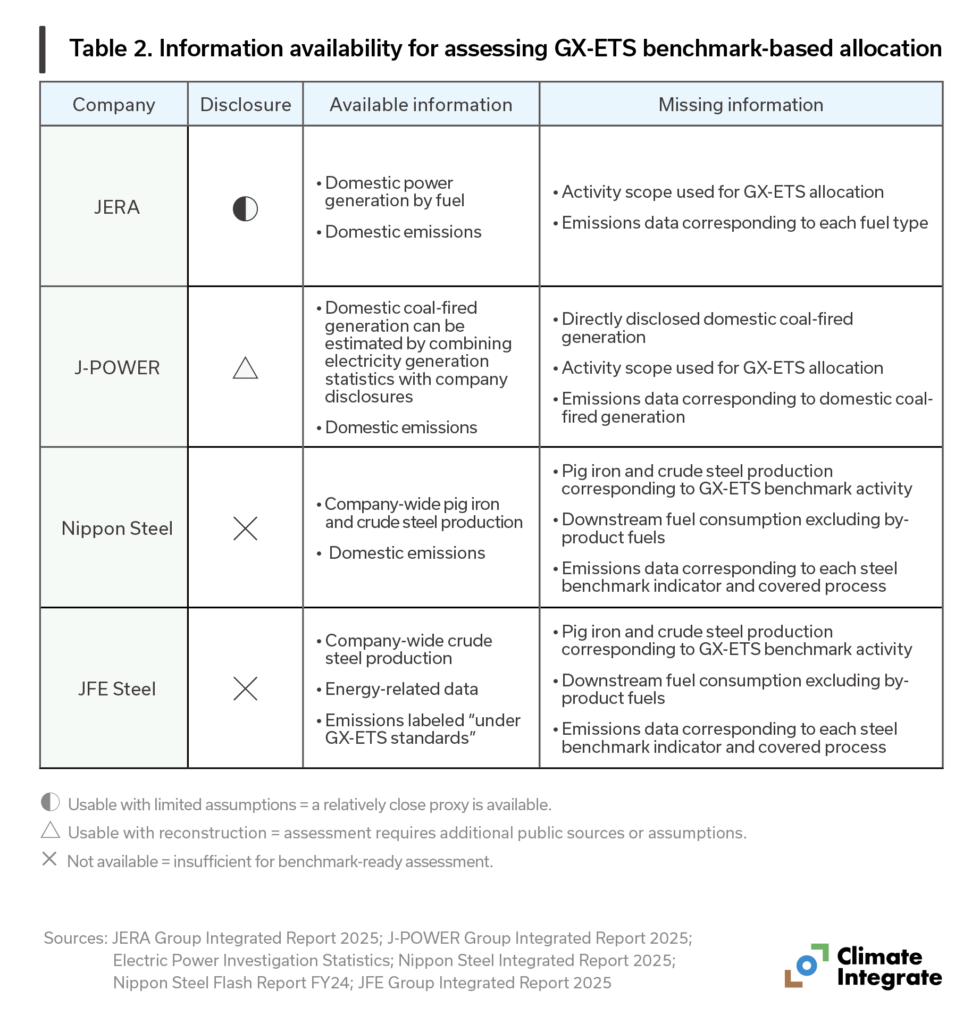
Table 2 summarizes the findings from the power and steel cases and shows which data needed for benchmark-based allocation are publicly available and which remain missing.
Source details
JERA Group Integrated Report 2025 (p.94, 96); J-POWER Group Integrated Report 2025 (p.111, 120–121); Electric Power Investigation Statistics (in Japanese); Nippon Steel Integrated Report 2025 (p.49); Nippon Steel Flash Report FY24 (p.27); JFE Group Integrated Report 2025 (p.93–94, 97)
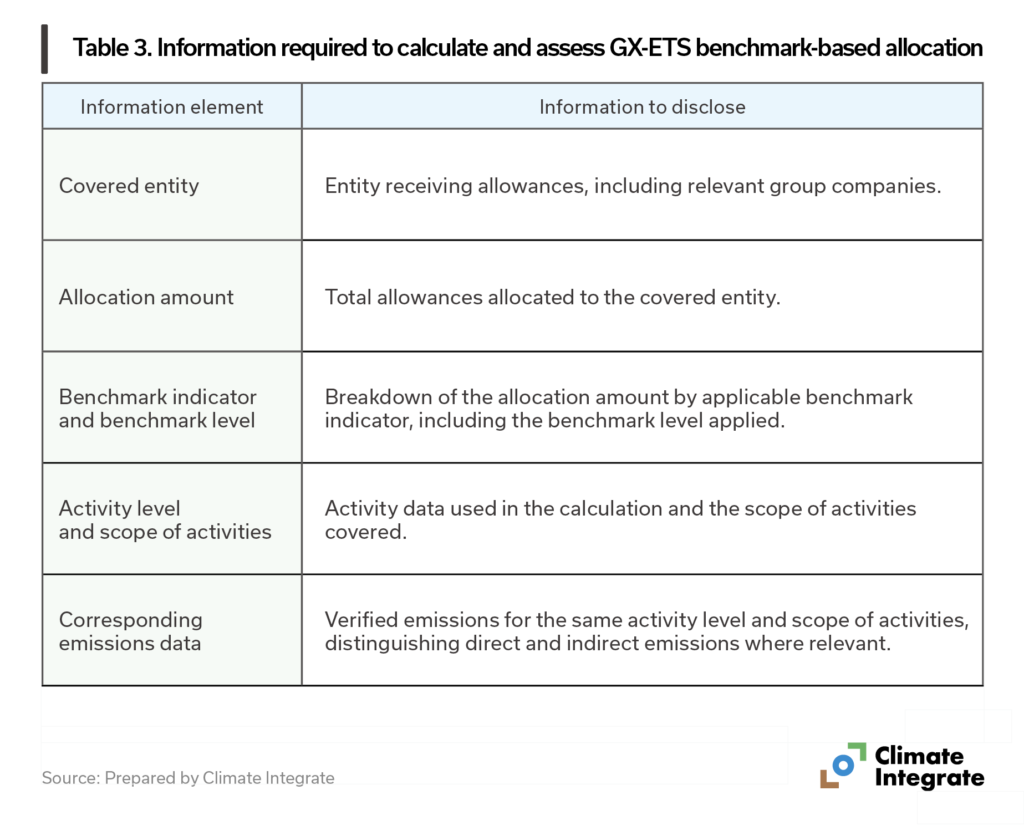
The current level of data availability makes it difficult not only to calculate companies’ benchmark-based allocation, but also to assess the stringency of that allocation. Without further disclosure, external observers cannot determine whether the allocation provides incentives for emission reductions. The key information needed to support such assessment are summarized in Table 3.
Under the current legal framework*, parts of companies’ transition plans are to be published. By contrast, although allocation amounts will be notified to individual covered companies, there is no provision for their general publication.
*Act on Promotion of a Smooth Transition to a Decarbonized Growth-Oriented Economic Structure (Article 73(2), 34(1)) (in Japanese)
Conclusion: Enhancing transparency for GX-ETS credibility
Benchmark-based allocation will be central to how effectively the GX-ETS operates in practice. The power and steel cases show that current publicly available information can provide useful reference points but does not contain data in a form that consistently corresponds to the way GX-ETS benchmarks are applied.
Disclosure of allocation amounts and verified emissions, as well as benchmark-relevant data used for the allocation, will be essential for examining how benchmark-based allocation works to drive emission reduction.
Public access to relevant information from companies’ transition plans, allocation amounts notified to each company, and the methods and underlying data used to calculate those amounts would allow external observers to assess how allocation is applied and how it relates to companies’ emissions performance.
As the GX-ETS enters full operation, policymakers and oversight actors, as well as investors, civil society organizations, and other stakeholders, will need to be able to track compliance and examine allocation amounts alongside verified emissions. Greater transparency can strengthen the credibility of GX-ETS as a policy tool that incentivizes corporate emission reductions and contributes to achieving Japan’s NDC.
