


Climate Integrate released a new report, “Japan’s Spending Plan for Climate and Energy 2026: Unpacking the National Budget and GX Investment.”
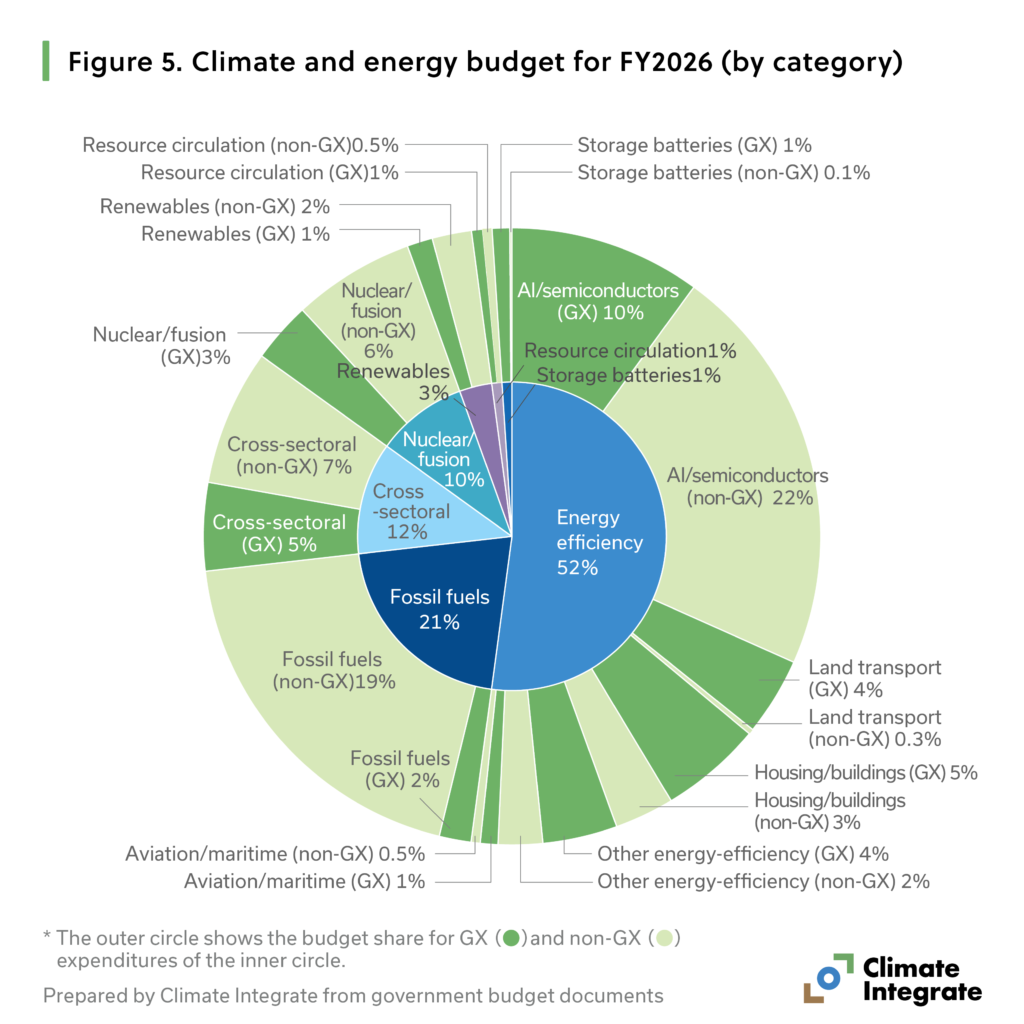
This report provides a comprehensive independent analysis of the government’s climate and energy budget. The analysis found that renewable energy accounts for 3% of the climate and energy related budget, a reduction from the previous year.
Key findings:
1. Only 3% for Renewables
Funds related to renewable energy account for 3% of the FY2026 climate and energy budget (4.7 trillion yen, 3.3% of the total government budget), a decrease in both percentage and amount compared to the previous fiscal year.
2. Significant increase for AI and semiconductors
By category, energy efficiency accounted for half (52%) of the climate and energy budget, with AI and semiconductors representing the largest share, having more than tripled compared to the previous year. This is followed by fossil fuels (21%), cross-sectoral (12%), and nuclear power and fusion energy (10%).
GX Budget: FY2023–2026
- The government is front-loading 20 trillion yen in investment over a 10-year period using funds raised through GX Transition Bonds, with the total GX budget over four years (FY2023–2026) amounting to 6.5 trillion yen.
- The GX budget is allocated up front to specific sectors such as AI/semiconductors and nuclear power, but the allocations do not match the stated 10-year targets for public and private investment (automobiles, next-generation renewable energy, in descending order).
- The issuance of Japan Climate Transition Bonds—the primary funding source for the GX budget—has been on a downward trend, reflecting a decline in investor demand.
To achieve Japan’s greenhouse gas (GHG) emission reduction targets, it will be crucial to improve the transparency of the government’s climate and energy budgets, rigorously assess their scale, allocation, and effectiveness, and re-examine the framework for annual budgetary measures and GX investments. It is also critical that industrial and financial policies be closely coordinated in the GX budget formulation process.
Co-authors’ comments
Yukimi Yamazaki (Researcher)
“Energy efficiency is the largest component of the government’s climate and energy budget. Within that category, a notable feature this year is that AI and semiconductors are given the largest share. Meanwhile, funding for renewable energy has dropped even further from last year’s already very low level, even though renewables are a crucial part of the energy transition. On top of that, the budget for nuclear power and fusion energy has increased, with the largest share being allocated to crisis management and advanced reactors. Overall, it remains unclear to what extent the budget scale and allocations for climate and energy will actually contribute to decarbonization, so more scrutiny is needed.”
Hiromi Mizota (Director, Sustainable Finance)
“The government has allocated a total of 6.5 trillion yen over four years for the GX budget. The issuance amount of Climate Transition Bonds—the primary funding source—has been decreasing since the first round in FY2023, reflecting a decline in investor demand. Going forward, it will be important to integrate industrial and financial policies, and to structure the Climate Transition Bonds to be more attractive to domestic and international investors.”
