

The Asia Zero Emission Community (AZEC), Japan’s regional cooperation platforms for energy transition and industrial decarbonization in Asia, brings together governments, public agencies, and private-sector entities (See our What’s AZEC? report and What’s New in AZEC? insight for more details).
As the number of AZEC Memorandums of Understanding (MoUs) has grown to several hundred, the central question is no longer only how many agreements have been signed, but what progress has been made on the projects under these agreements.
This Insight examines the progress of projects under the AZEC MoUs agreed by the end of 2024, based on publicly available information*. While facing challenges in collecting information on all projects, we classified the projects according to their stage of development to understand the status of the implementation of AZEC to date. We also examined the challenges in assessing AZEC’s contribution to decarbonization in Asia.
*Publicly available information refers to sources such as government documents, AZEC Progress Reports issued by ERIA (Economic Research Institute for ASEAN and East Asia) and METI (Ministry of Economy, Trade and Industry) materials, company press releases, project websites, and other publicly accessible sources.
Methodology
Among the AZEC MoUs agreed up to now, we target a total of 217 MoUs agreed in 2023 and 2024. MoUs in 2025 or later are excluded from the analysis in order to focus on projects that have had sufficient time for follow-up progress to be reflected.
Out of 217 MoU projects, the information to confirm the status of 139 projects could be found through publicly available information. The remaining 78 projects, about 35% of the total, could not be assessed due to the lack of publicly available information and were thus excluded from this analysis.
Accordingly, this analysis examines the status of 139 projects. It should be noted that even where project status could be confirmed, important information such as project timelines, financing status, expected emissions impact, and alignment with partner countries’ energy transition strategies often remain unavailable or outdated.
The status of each project is classified into five stages, based on our own definition at Climate Integrate. The five stages are defined as follows:
Stage 0: Agreement
An MoU, agreement, partnership, roadmap, capacity-building activity, or general cooperation framework has been announced, but no specific project development has occurred yet.
Stage 1: Research / Planning
The project has moved into feasibility study, research, FEED (Front End Engineering Design), detailed design, pilot, demonstration, technical testing, or other preparatory activity.
Stage 2: Development
FID (Final Investment Decision), procurement, construction, installation, or another implementation-related milestone has been confirmed.
Stage 3: Operation
The project, facility, service, program, or activity is operating, commercialized, delivered, or in active use.
Stage 4: Others
The project is relevant to AZEC but does not clearly fit the main project development stages above.
Current Status of AZEC MoU Projects
While underscoring the limits of the information available, we analyzed the status of the 139 MoU projects as below.
Among the 139 MoU projects, the largest share (67%) is at Stage 1 (Research / Planning), followed by Stage 0 (Agreement) (14%) and Stage 2 (Development) (11%). This indicates that most projects remain in the early stages of progress (Figure 1).

Across cooperation areas, Hydrogen and Ammonia accounts for the largest number of projects, concentrated at Stage 1 (Research / Planning). In contrast, Renewable Energy and Biomass/Biofuel have a higher share of projects that have progressed to Stage 2 (Development) and Stage 3 (Operation) (Figure 2).

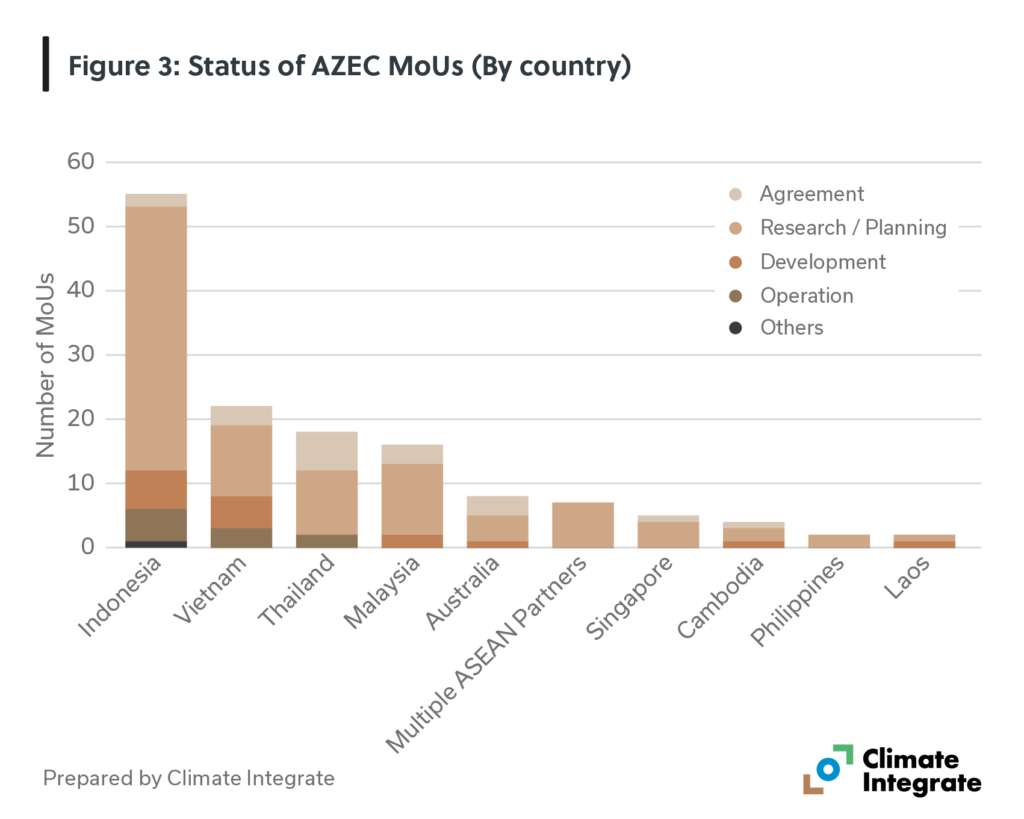
The country-specific breakdown of MoUs shows that Indonesia has by far the largest number of projects in progress, followed by Vietnam, Thailand, Malaysia, and Australia (Figure 3). This distribution is consistent with the broader AZEC MoU landscape, where Indonesia has been the most active partner and where large state-linked energy and utility actors are central to implementation.
Conclusion
This analysis examined the progress of AZEC MoU projects based on publicly available information. Among the 217 MoUs agreed by the end of 2024, the status of 139 projects could be identified. However, we could not find any information to identify the status of the rest of 78 projects, about 35% of the total.
Among 139 projects, we found
- 67% are at Stage 1 (Research / Planning), followed by Stage 0 (Agreement) (14%), suggesting that most AZEC MoU projects with available progress information are still at an early stage.
- 18% of projects have progressed to Stage 2 (Development) or Stage 3 (Operation), demonstrating that a subset of MoUs have moved beyond planning into tangible project progress.
- Hydrogen and Ammonia accounts for the largest number of projects with confirmed status, concentrated at Stage 1 (Research / Planning).
- Renewable Energy and Biomass/Biofuel show relatively stronger progress to Stage 2 (Development) or beyond, including projects that have reached operation.
However, even for these 139 projects, we could not confirm the details of the projects, such as project timelines, financing status, expected emissions impact, and alignment with partner countries’ energy transition strategies.
These findings underscore the importance of enhancing transparency in tracking AZEC projects. As AZEC is a Japanese government-led initiative supported by public funding, and some of the projects may be connected to a credit and offset program for Japanese companies to meet their own targets under the Japan’s emissions trading system (GX-ETS), it is important to be accessible to up-to-date information on how projects are progressing, what stage they have reached, and how they contribute to partner countries’ decarbonization pathways.
Developing a publicly accessible platform providing regular updates on project-level information would enable all involved partner countries and their stakeholders to better understand the implementation and outcomes of AZEC projects and receive benefit from them. Such transparency will also provide a stronger basis for Japan’s contribution to Asia’s decarbonization.
